Step-by-Step Instructions
1. Prepare your workplace
Make sure you have a well-ventilated work area and that all ingredients and utensils are prepared. Safety is important, especially since you will be working with a strong base.
2. Mix Potassium Hydroxide and Water
Measure out the amount of water needed and pour it into a heat-resistant container. Slowly add the potassium hydroxide to the water (never the other way around!) and stir gently until it is completely dissolved. The solution will be hot, so let it cool to about 30–40 degrees Celsius.
3. Add the Linseed Oil
Measure out the linseed oil and pour it into a large container. Heat the linseed oil to the same temperature as the KOH solution (30–40 degrees Celsius). Once both liquids are at the correct temperature, slowly pour the KOH solution into the linseed oil while stirring continuously. A hand blender can be used to mix effectively, but be careful not to overheat the mixture.
4. The saponification process
The mixture will thicken as saponification occurs. Continue stirring until the mixture reaches a "trace" – this means that when you draw a line in the soap with the whisk or spoon, the line should remain visible for a while before disappearing.
5. Boil and ripen
After the soap reaches "trace", place it in a pot and let it simmer on low heat for 1-2 hours. Stir occasionally. After boiling, let the soap cool and store it in a tightly sealed container. Let the soap mature for at least a week before using - the longer it matures, the better quality you will get.
Customization and Variations
- Additives : You can experiment with adding essential oils for fragrance, or natural dyes to give your soap a unique character.
- Saponification value : Be sure to calculate the correct amount of KOH depending on the amount of linseed oil, this is to get a perfectly balanced soap that is not too strong.
Ingredients for 1 liter of linseed oil
Linseed oil : 1 liter
Potassium hydroxide (KOH) : 140–150 grams
Water : Approximately 500 ml (this may vary depending on the consistency and desired thickness)
Calculation and Tips:
The amount of potassium hydroxide can vary slightly depending on the fatty acid composition of the oil. An exact value would require a saponification value for that particular oil, but 140–150 grams is a standard amount for linseed oil.
The amount of water can be adjusted during the process if the mixture feels too thick or too thin.
---
To create a linseed oil soap with a final product containing 40% unsaturated linseed oil, we do a so-called "superfatting" (overfatting) where we leave a certain percentage of the oil unsaponified. This means that we use less potassium hydroxide (KOH) than is needed to saponify all the oil, which leaves some linseed oil unchanged in the final product.
Here's how you can think:
Calculate the total amount of KOH for full saponification:
For 1 liter (about 910 grams) of linseed oil, approximately 140–150 grams of KOH are normally required to saponify all the linseed oil.
Adjust for 40% unsaturated linseed oil:
If you want 40% of the linseed oil to remain as unsaturated oil in the final product, this means you only want to saponify 60% of the linseed oil.
60% of 910 grams of linseed oil is approximately 546 grams (or 0.6 liters).
Calculate KOH for 60% of the linseed oil:
Now you use KOH to saponify only 546 grams of linseed oil instead of the entire amount.
KOH for 546 grams of linseed oil: 140 g×0.6=84 grams
Summary recipe:
- Linseed oil : 1 liter
- KOH : about 84 grams
- Water : about 500 ml (adjust if necessary)
This method leaves approximately 40% of the linseed oil unsaponified, resulting in a milder and more moisturizing soap.
Uses for Your Homemade Linseed Oil Soap
Once your soap is ready, you can use it for a variety of tasks. Here are some suggestions:
- Cleaning : Perfect for cleaning surfaces in the home, both hard and soft.
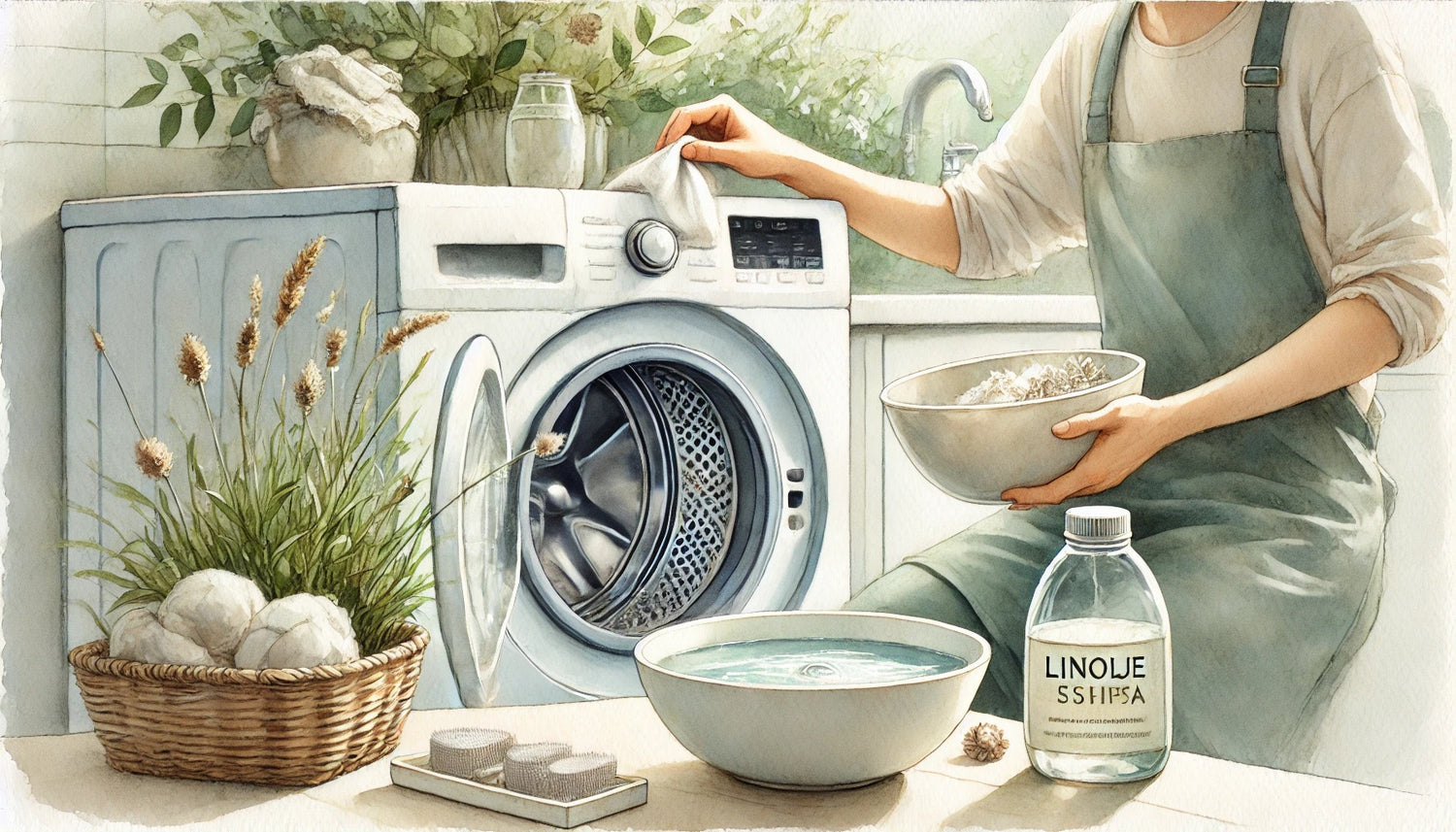
- Laundry : Use the soap to wash clothes, especially delicate materials.
- Garden : Gentle for washing garden tools and for controlling aphids.
- Floor treatment : Ideal for cleaning and maintaining wooden floors.
Vill du komma igång direkt? Vi har satt ihop ett paket som vi själva använder.